
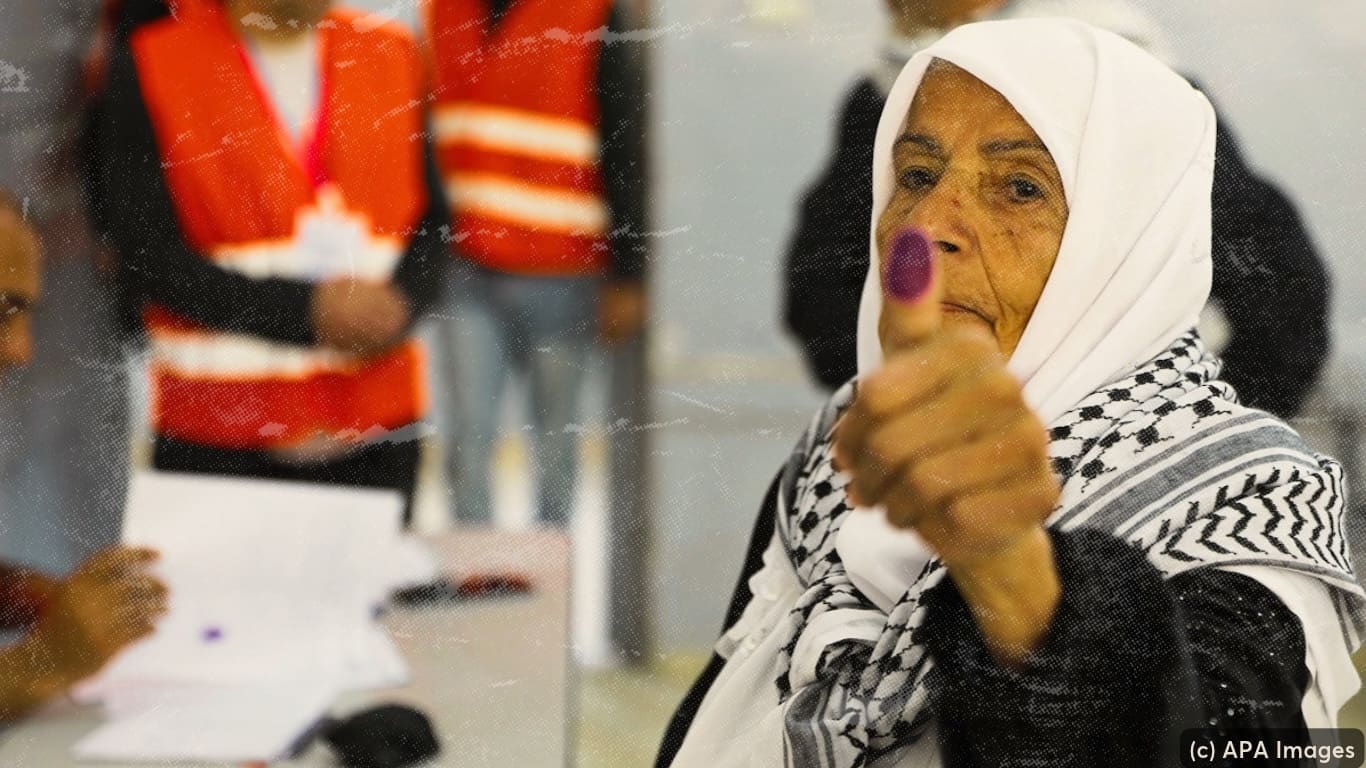
In February 2026, Palestinian Authority (PA) President Mahmoud Abbas issued a decree stating that Palestinian National Council (PNC) and Palestinian Legislative Council (PLC) elections would take place in November. In October, he postponed the PLC elections, citing obstacles from the Israeli regime. The PNC elections have been held only in limited locations, as little more than a mechanism to select predetermined candidates. As for the 2027 presidential elections, Abbas is unlikely to hold them, even though he has exceeded his electoral mandate by nearly 18 years. An election would simply not bode well for him: his popularity ratings are very low, and he is, after all, the world’s second-oldest president.
In this commentary, Yara Hawari and Alaa Tartir engage with electoral significance within the settler-colonial context where the Israeli regime has been foreclosing Palestinian political agency across Palestine. While elections alone cannot measure democracy or mark enfranchisement, they nevertheless grapple with the value of Palestinian representation and how democratic participation can play out under settler colonialism.

Al-Shabaka Commentary, Beyond Elections: Palestinian Popular Sovereignty, by Yara Hawari and Alaa Tartir, November 2026

